Pages

Friday, July 13, 2012

Clouds of Witness, Ch 5, continued


Information obtained from Captain Cathcart's papers:

                Before the war Denis Cathcart had undoubtedly been a rich man. He had considerable investments in Russia and Germany and a large share in a prosperous vineyard in Champagne.
The Champagne wine region (archaic English: Champany) is a historic province within the administrative province of Champagne in the northeast of France. The area is best known for the production of the sparkling white wine that bears the region's name. EU law and the laws of most countries reserve the term "Champagne" exclusively for wines that come from this region located about 100 miles (160 km) east of Paris. The viticultural boundaries of Champagne are legally defined and split into five wine producing districts within the administrative province: Aube, Côte des Blancs, Côte de Sézanne, Montagne de Reims, and Vallée de la Marne. The towns of Reims and Épernay are the commercial centers of the area.

Located at the northern edges of the wine growing world, the history of the Champagne wine region has had a significant role in the development of this unique terroir. The area's proximity to Paris promoted the region's economic success in its wine trade but also put the villages and vineyards in the path of marching armies on their way to the French capital. Despite the frequency of these military conflicts, the region developed a reputation for quality wine production in the early Middle Ages and was able to continue that reputation as the region's producers began making sparkling wine with the advent of the great Champagne houses in the 17th & 18th centuries. The principal grapes grown in the region include Chardonnay, Pinot Noir, and Pinot Meunier. Pinot Noir is the most widely planted grape in the Aube region and grows very well in Montagne de Reims. Pinot Meunier is the dominant grape in the Vallée de la Marne region. The Côte des Blancs is dedicated almost exclusively to Chardonnay
                After coming into his property at the age of twenty-one he had concluded his three years' residence at Cambridge, and had then travelled a good deal, visiting persons of importance in various countries, and apparently studying with a view to a diplomatic career. During the period from 1913 to 1918 the story told by the books became intensely interesting, baffling, and depressing. At the outbreak of war he had taken a commission in the 15th —— shires. With the help of the cheque-book, Parker reconstructed the whole economic life of a young British officer—clothes, horses, equipment, travelling, wine and dinners when on leave, bridge debts, rent of the flat in the Rue St. Honoré, club subscriptions, and what not.
Bridge is a game of skill played with randomly dealt cards, which makes it also a game of chance, or more exactly, a tactical game with inbuilt randomness, imperfect knowledge and restricted communication. The chance element is in the deal of the cards; in competitions and clubs the chance element is largely eliminated by comparing results of multiple pairs in identical situations. This is achievable when there are eight or more players, sitting at two or more tables, and the deals from each table are preserved and passed to the next table, thereby duplicating them for the next table of participants to play. At the end of a session, the scores for each deal are compared, and the most points are awarded to the players doing the best with each particular deal. This measures skill because each player is being judged only on the ability to bid with, and play, the same cards as other players. However very often even the most skillful play will only succeed some of the time, and the skilled player may be unlucky because an alternative, less expert play achieves a better result. But in the long run the expert player will score better.

This form of the game is referred to as duplicate bridge and is played in clubs and tournaments, which can gather as many as several hundred players. Duplicate bridge is a mind sport, and its popularity gradually became comparable to that of chess, with which it is often compared for its complexity and the mental skills required for high-level competition. Bridge and chess are the only "mind sports" recognized by the International Olympic Committee, although they were not found eligible for the main Olympic program.

The basic premise of duplicate bridge had previously been used for whist matches as early as 1857. Initially, bridge was not thought to be suitable for duplicate competition; it wasn't until the 1920s that (auction) bridge tournaments became popular.

In 1925 when contract bridge first evolved, bridge tournaments were becoming popular, but the rules were somewhat in flux, and several different organizing bodies were involved in tournament sponsorship: the American Bridge League (formerly the American Auction Bridge League, which changed its name in 1929), the American Whist League, and the United States Bridge Association. In 1935, the first officially recognized world championship was held. By 1937, however, the American Contract Bridge League had come to power (a union of the ABL and the USBA), and it remains the principal organizing body for bridge tournaments in North America. In 1958, the World Bridge Federation was founded to promote bridge world-wide, coordinate periodic revision to the Laws (each ten years, next in 2017) and conduct world championships
                This outlay was strictly moderate and proportioned to his income. Receipted bills, neatly docketed, occupied one drawer of the bureau, and a careful comparison of these with the cheque-book and the returned cheques revealed no discrepancy. But, beyond these, there appeared to have been another heavy drain upon Cathcart's resources. Beginning in 1913, certain large cheques, payable to self, appeared regularly at every quarter, and sometimes at shorter intervals. As to the destination of these sums, the bureau preserved the closest discretion; there were no receipts, no memoranda of their expenditure.
                The great crash which in 1914 shook the credits of the world was mirrored in little in the pass-book.
Preoccupied with internal problems, France played little attention to foreign policy in the 1911-14 period, although it did extend military service to three years from two over strong Socialist objections in 1913. The rapidly escalating Balkan crisis of 1914 caught France unawares, and it played only a small role in the coming of World War I. The Serbian crisis triggered a complex set of formal and secret military alliances between European states, causing most of the continent, including France, to be drawn into war within a few short weeks. Austria-Hungary declared war on Serbia in late July, triggering Russian mobilization. On 1 August both Germany and France ordered mobilization. Germany was much better prepared militarily than any of the other countries involved, including France. Later on that day the German Empire, as an ally of Austria, declared war on Russia. France was allied with Russia and so was ready to commit to war against the German Empire. Germany on August 3 declared war on France, going through Belgium. Britain entered the war on 4 August, and started sending in troops on 7 August.
                The credits from Russian and German sources stopped dead; those from the French shares slumped to a quarter of the original amount, as the tide of war washed over the vineyards and carried the workers away. For the first year or so there were substantial dividends from capital invested in French rentes; then came an ominous entry of 20,000 francs on the credit side of the account, and, six months after, another of 30,000 francs. After that the landslide followed fast. Parker could picture those curt notes from the Front, directing the sale of Government securities, as the savings of the past six years whirled away in the maelstrom of rising prices and collapsing currencies. The dividends grew less and less and ceased; then, more ominous still, came a series of debits representing the charges on renewal of promissory notes.
                About 1918 the situation had become acute, and several entries showed a desperate attempt to put matters straight by gambling in foreign exchanges. There were purchases, through the bank, of German marks, Russian roubles, and Roumanian lei.
The leu (Romanian pronunciation: [lew], plural lei [lej]; ISO 4217 code RON; numeric code 946) is the currency of Romania. It is subdivided into 100 bani (singular: ban). The name of the currency means "lion". On 1 July 2005, Romania underwent a currency reform, switching from the previous leu (ROL) to a new leu (RON). 1 RON is equal to 10,000 ROL. The currency of Moldova is also called the leu, but is independent of the Romanian leu.

Romania joined the European Union on 1 January 2007 and it is expected to adopt the euro in 2015    
   Mr. Parker sighed sympathetically, when he saw this, thinking of £12 worth of these delusive specimens of the engraver's art laid up in his own desk at home. He knew them to be waste paper, yet his tidy mind could not bear the thought of destroying them. Evidently Cathcart had found marks and roubles very broken reeds.
                It was about this time that Cathcart's pass-book began to reveal the paying in of various sums in cash, some large, some small, at irregular dates and with no particular consistency. In December, 1919, there had been one of these amounting to as much as 35,000 francs. Parker at first supposed that these sums might represent dividends from some separate securities which Cathcart was handling for himself without passing them through the bank. He made a careful search of the room in the hope of finding either the bonds themselves or at least some memorandum concerning them, but the search was in vain, and he was forced to conclude either that Cathcart had deposited them in some secret place or that the credits in question represented some different source of income.

                Cathcart had apparently contrived to be demobilized almost at once (owing, no doubt, to his previous frequentation of distinguished governmental personages), and to have taken a prolonged holiday upon the Riviera.
Demobilized, or “demobbed” from the Army.

Clouds of Witness cont


                “No, does he now?” said Lord Peter. “To think of that. Just the fellow I want to see. Model farmer, what? Wherever I go throughout the length and breadth of the North Riding I hear of Mr. Grimethorpe. 'Grimethorpe's butter is the best'; 'Grimethorpe's fleeces Never go to pieces'; 'Grimethorpe's pork Melts on the fork'; 'For Irish stews Take Grimethorpe's ewes'; 'A tummy lined with Grimethorpe's beef, Never, never comes to grief.' It has been my life's ambition to see Mr. Grimethorpe in the flesh. And you no doubt are his sturdy henchman and right-hand man. You leap from bed before the breaking day, To milk the kine amid the scented hay. You, when the shades of evening gather deep, Home from the mountain lead the mild-eyed sheep. You, by the ingle's red and welcoming blaze, Tell your sweet infants tales of olden days! A wonderful life, though a trifle monotonous p'raps in the winter. Allow me to clasp your honest hand.”
This appears to be a peaen made up by Sayers herself. I can find no record of it anywhere else.
                Whether the man was moved by this lyric outburst, or whether the failing light was not too dim to strike a pale sheen from the metal in Lord Peter's palm, at any rate he moved a trifle back from the gate.
                “Thanks awfully, old bean,” said Peter, stepping briskly past him. “I take it I shall find Mr. Grimethorpe in the house?”
                The man said nothing till Wimsey had proceeded about a dozen yards up the flagged path, then he hailed him, but without turning round.
Flagstone (flag) is a generic flat stone, usually used for paving slabs or walkways, patios, fences and roofing. It may be used for memorials, headstones, facades and other constructions. The name derives from Middle English flagge meaning turf, perhaps from Old Norse flaga meaning slab or chip

Flagstone is a sedimentary rock that is split into layers along bedding planes. Flagstone is usually a form of a sandstone composed of feldspar and quartz and is arenaceous in grain size (0.16 mm – 2 mm in diameter). The material that binds flagstone is usually composed of silica, calcite, or iron oxide. The rock color usually comes from these cementing materials. Typical flagstone colors are red, blue, and buff, though exotic colors exist.

Flagstone is quarried in places with bedded sedimentary rocks with fissile bedding planes. Examples include Arizona flagstone and Pennsylvania Bluestone.
Lauze stone in Lannion (Brittany)

Around the thirteenth century, the ceilings, walls and floors in European architecture became more ornate. Anglo-Saxons in particular used flagstones as flooring materials in the interior rooms of castles and other structures.[2] Lindisfarne Castle in England and Muchalls Castle (14th century) in Scotland are among many examples of buildings with surviving flagstone floors
                “Mester!”
                “Yes, old thing?” said Peter affably, returning.
                “Happen he'll set dog on tha.”
                “You don't say so?” said Peter. “The faithful hound welcomes the return of the prodigal.
The Prodigal Son, also known as Two Sons, Lost Son and Prodigal Father is one of the parables of Jesus. It appears in only one of the Canonical gospels of the New Testament. According to the Gospel of Luke (Luke 15:11-32), a father, in response to his demands, gives the younger of his two sons his inheritance before he dies. The younger son, after wasting his fortune (the word 'prodigal' means 'wastefully extravagant'), repents and returns home, where the father holds a feast to celebrate his return. The older son refuses to participate, stating that in all the time the son has worked for the father, he did not even give him a goat to celebrate with his friends. His father reminds the older son that everything the father has is the older son's, but that they should still celebrate the return of the younger son as he has come back to them. It is the third and final part of a cycle on redemption, following the Parable of the Lost Sheep and the Parable of the Lost Coin.

In Western Catholic tradition, this parable is usually read on the third Sunday of Lent, while in the Eastern Orthodox Church it is read on the Sunday of the Prodigal Son.
                 Scene of family rejoicing. 'My own long-lost boy!' Sobs and speeches, beer all round for the delighted tenantry. Glees by the old fireside, till the rafters ring and all the smoked hams tumble down to join in the revelry. Good night, sweet Prince, until the cows come home and the dogs eat Jezebel in the portion of Jezreel when the hounds of spring are on winter's traces. I suppose,” he added to himself, “they will have finished tea.”
“ Good night, sweet Prince” is what Horatio says to the dying Hamlet in the play of the same name by Will Shakespeare.

Jezebel (fl. 9th century BC) was a princess, identified in the Hebrew Book of Kings as the daughter of Ethbaal, King of Tyre (Phoenicia) and the wife of Ahab, king of north Israel. According to genealogies given in Josephus and other classical sources, she was the great-aunt of Dido, Queen of Carthage.

Jezebel was a power behind the throne. Ahab and Jezebel allowed temples of Baal to operate in Israel, and that religion received royal patronage. After Ahab's death, Ahaziah and Jehoram, his sons by Jezebel, acceded to the throne. The prophet Elisha had one of his servants anoint Jehu as king to overthrow the house of Ahab. Jehu killed Jehoram as he attempted to flee in his war chariot.

Jehu confronted Jezebel in Jezreel, where he incited her court officials to murder the queen by throwing her out of a window and leave her corpse to be eaten by dogs. Jezebel became associated with false prophets. In some interpretations, her dressing in finery and putting on makeup before her death led to the association of use of cosmetics with "painted women" or prostitutes.

“The hounds of spring are on winter’s traces” is from t he poem Atalanta in Calydon (1865).

Wednesday, July 11, 2012

Oxford: Literary Legend

From Huffpost Travel:  Oxford: Literary Legend


Oxford is sui generis, literally "of its own kind."

Poet Matthew Arnold described it as "that sweet city with her dreaming spires." It is home to the oldest university in the English-speaking world, comprised of 38 independent colleges, such as Magdalen, Balliol and Keble. Founded in the 13th century, this ancient university is the core of a beautiful rural region, which includes the Chilterns and the Cotswolds.
Blenheim Palace and the spectacular gardens of Rousham House are nearby. So are storybook villages like Chipping Campden.
But the big draw is the colleges, notable for their architecture and graduates. Most have open hours for visitors and entry fees. Entrance is considered a privilege, not a right. St. Edmund Hall flew the Union Jack in its quad in honor of the Queen's Jubilee. 2012-07-04-UseEagle.jpg
To pop culture fans, Oxford is something more.
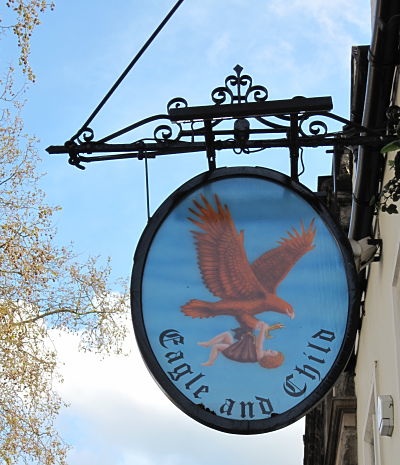
It claims literary giants, such as Lewis Carroll, Oscar Wilde, Graham Greene and Evelyn Waugh, as its own. Several famous writers, including J.R.R. Tolkien and C.S. Lewis, also taught here. Both men, part of The Inklings, met in The Eagle and Child pub in St. Giles Street. Discussions in the Rabbit Room, which bears mementos of their patronage, contributed to Lewis' Narnia books and Tolkien's Lord of the Rings series.
So it's no surprise that Oxford is the backdrop for beloved books.
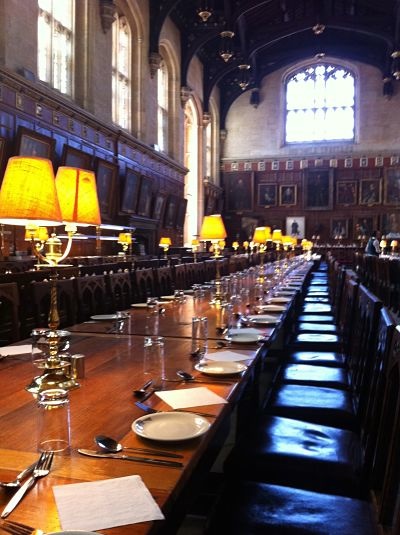
The magnificent Christ Church dining hall doubles as the Great Hall at Hogwarts for the Harry Potter films, while The New College cloisters are seen in Harry Potter and the Goblet of Fire. The Pitts River Museum, which has a renowned archeology and anthropology collection, is said to have inspired Diagon Alley. Plus, the Bodleian Library serves as Hogwarts infirmary and a dance practice room. 2012-07-04-USEChristChurch.jpg
Magic aside, the Bodleian is a treasure trove for scholars.
It houses the original manuscript of Frankenstein, a Gutenberg Bible and one-quarter of the world's original copies of the Magna Carta. The Bodleian's "Dickens and His World" exhibit, through Oct. 28, celebrates the bicentenary of the great Victorian novelist. The Radcliffe Camera, an architectural jewel, is the main reading room of the library. It's also a visual marker in numerous productions, including Inspector Morse, The Golden Compass and Brideshead Revisited.
Brideshead Revisited, Waugh's homage to pre-war Britain, opens in "a city of aquatint." Waugh attended Hertford, as does his protagonist Charles Ryder, recognizable by its famed Bridge of Sighs. It's just behind the gates to the graceful Sheldonian Theatre, which Christoper Wren designed to imitate a classical Roman theater. Name aside, it's known for its music recitals.
2012-07-04-USEBridgeofSighs.jpgLike Ryder, visitors can punt on the Cherwell. It's a languid way to see Oxford, though the city is walkable. Just remember the same street can change its name several times.
To tout its literary history, there are wonderful tours, given by the Oxford Visitor Information Centre, as well as The Oxford Monocle Tours. Writers as diverse as Oscar Wilde and Dorothy Sayers are featured. Lewis Carroll, a pseudonym for mathematics lecturer Charles Dodgson, used Alice Liddell, his dean's daughter, as the model for Alice in Wonderland.
By the mid 20th-century, spy novels and police procedurals were in vogue. Oxford's John Buchan wrote The 39 Steps; John le Carré, known for Tinker, Tailor, Soldier, Spy, was recruited by the British Security Service while still an undergrad.

Though a Cambridge man, Colin Dexter's Inspector Morse series is set and shot in Oxford. Dexter makes a cameo appearance in almost all TV episodes. Crusty detective Morse suffers his fatal heart attack in the Exeter College courtyard. Philip Pullman, a graduate of Exeter and the author of the fantasy trilogy His Dark Materials, locates his Lyra stories here.


Sunday, July 8, 2012

Detachment

From Scientific American:  Detachment

There’s an intersection in Boston outside one of my favorite places to eat. At the corner of two bustling streets is a white bike, chained in place, surrounded by flowers. In loving memory.
***
One evening earlier this month, I was riding the ‘T,’ Boston’s streetcar system, when our train suddenly stopped.
There were the usual sights and sounds of delayed passengers: people fiddled with cell phones, glanced at watches, tapped feet impatiently. Outside, the flashing of police cars lit the night. “Maybe we should catch a taxi,” my friend said, and I agreed. We asked the driver to please open the train doors.
“Can’t go anywhere yet,” he said. “See that dead body?”
“What?”
The few of us near enough to hear him went to the window. Motionless on the pavement was a human-size lump, covered with a white sheet. Next to it, a mangled bicycle. Wheels facing up. Tires and handlebars twisted. Around them, cops were talking. Or were they? It was hard to tell.
Mostly I noticed the way they were standing. In a circle, surrounding the sheet. This was not an unusual occurrence to them, and it showed on their expressionless faces. They were doing their job, and I’m sure they were doing it well.
I’m not sure why their lack of open emotion surprised me. But it did.
***
At the beginning of first year, we were asked to reflect on several aspects of becoming a physician. One of our prompts said this: “Doctors must simultaneously care deeply about their patients and yet maintain detachment. In what ways is detachment a positive, and in what ways can it be a negative, in the doctor-patient relationship?”
“I understand that as a physician, I will be immersed in people’s lives to the point that I will feel closely invested in their outcomes,” I wrote. “While I am concerned about confusing a patient for a host of disease, I also recognize the value of keeping some distance to allow for logical processing of medical issues…”
The person on the bicycle that night was not my patient. I know my feeling of connection is not rational; that it was provoked not by any meaningful relationship, but by the arbitrary circumstances of a T ride through Boston one evening. That people pass away all the time. Almost two per second, I read somewhere. I don’t have the capacity to mourn them all. That’s the right of parents and children, spouses and siblings, other relatives, friends, neighbors, coworkers, religious leaders, caregivers. The rest of us can feel horror, remorse, sympathy – but can a stranger truly mourn?
A bit of detachment is a functional and professional necessity. But it’s hard. For days, I Googled the name of the intersection and “bike crash,” waiting for the media to confer a face, a name, and an existence to what lay beneath the white sheet. I needed to know that a person, not just a body, was there. A person with a life, a personality, stories, friends, memories. In some way, it felt disrespectful not to know.
Maybe I felt that way because of how instantaneously a person becomes a body becomes a statistic. I thought of the graph they’ve shown us in medical school on the most common causes of mortality in the United States. A bar for heart disease. A bar for cancer. Followed by the third biggest cause of deaths in the US: accidents. The person on the bike couldn’t fade into that. Not yet.
Sometime while we were on that train, a bus was traveling in one direction, and a bicycle was traveling in another. Sometime while we were on that same train, everything was fine. Then: a blip in the universe, and something awful and irreversible.
I can’t help but feel that there’s something deeply flawed with a world that can take a person’s life without even giving her time to process it.
“I do not want to let the heartache that comes from one unfortunate outcome become such an overwhelming emotional drain that it detracts from my ability to care for others.”
I know I can’t mourn everyone. I know, especially, that I don’t have the right to mourn the woman on the bicycle. To write about her. I never knew her, while others did. Others loved her.
I am so, so sorry for your loss.
***
The train eventually started moving again, and my friend and I sat in silence. Talking about the details of our days so soon after seeing what we did felt wrong. I alternated between looking out the window and at my feet. Partially I was looking away to hide my wet eyes.
“Do you think you’ll ever become desensitized?” he asked me after a while.
“I don’t know. I guess I have to, a little bit.” I said. “But I’m not sure I want to.”
Ilana YurkiewiczAbout the Author: Ilana Yurkiewicz is a second year student at Harvard Medical School who graduated from Yale University with a B.S. in biology. She was a science reporter for The News & Observer in Raleigh, North Carolina via the AAAS Mass Media Fellowship and then went on to write for Science Progress in Washington, DC. She has an academic interest in bioethics, currently conducting ethics research at Harvard after previously interning at the Presidential Commission for the Study of Bioethical Issues. Follow on Twitter @ilanayurkiewicz.


Tuesday, July 3, 2012

CLouds of Witness cont


Behind Riddlesdale Lodge the moor stretched starkly away and upward. The heather was brown and wet, and the little streams had no color in them. It was six o'clock, but there was no sunset. Only a paleness had moved behind the thick sky from east to west all day. Lord Peter, tramping back after a long and fruitless search for tidings of the man with the motor-cycle, voiced the dull suffering of his gregarious spirit. “I wish old Parker was here,” he muttered, and squelched down a sheep-track.

                He was making, not directly for the Lodge, but for a farmhouse about two and a half miles distant from it, known as Grider's Hole. It lay almost due north of Riddlesdale village, a lonely outpost on the edge of the moor, in a valley of fertile land between two wide swells of heather. The track wound down from the height called Whemmeling Fell, skirted a vile swamp, and crossed the little River Ridd about half a mile before reaching the farm.
“Fell” (from Old Norse fell, fjall, "mountain”) is a word used to refer to mountains, or certain types of mountainous landscape, in Scandinavia, the Isle of Man, and parts of northern England.         
 Peter had small hope of hearing any news at Grider's Hole, but he was filled with a sullen determination to leave no stone unturned.
(Every site I look at tells you the obvious – what it means. Not one tells you what the origin of it is!)
                Privately, however, he felt convinced that the motor-cycle had come by the high road, Parker's investigations notwithstanding, and perhaps passed directly through King's Fenton without stopping or attracting attention. Still, he had said he would search the neighborhood, and Grider's Hole was in the neighborhood. He paused to relight his pipe, then squelched steadily on. The path was marked with stout white posts at regular intervals, and presently with hurdles.
A hurdle is a moveable section of light fence. Traditionally they were made from wattle (woven split branches), but modern hurdles are often made of metal. Hurdles are used for handling livestock, as decorative fencing, for horse racing and in the track and field event of hurdling.
                The reason for this was apparent as one came to the bottom of the valley, for only a few yards on the left began the stretch of rough, reedy tussocks, with slobbering black bog between them, in which anything heavier than a water-wagtail would speedily suffer change into a succession of little bubbles.
Tussock grasses or bunch grasses are found as native plants in natural ecosystems, as forage in pastures, and as ornamental grasses in gardens. Flint Tussock and bunch grasses, in the Poaceae family, are grasses that usually grow as singular plants in clumps, tufts, or bunches, rather than forming a sod or lawn, in meadows, grasslands, and prairies. As perennial plants usually, they live more than one season

Many species have long roots that may reach 2-metre (6.6 ft) or more into the soil, which can aid slope stabilization, erosion control, and soil porosity for precipitation absorption. Also, their roots can reach moisture more deeply than other grasses and annual plants during seasonal or climatic droughts. The plants provide habitat and food for insects (including Lepidoptera), birds, small animals and larger herbivores, and support beneficial soil mycorrhiza. The leaves supply material, such as for basket weaving, for indigenous peoples and contemporary artists.

Tussock and bunch grasses occur in almost any habitat where other grasses are found, including: grasslands, savannas and prairies, wetlands and estuaries, riparian zones, shrublands and scrublands, woodlands and forests, montane and alpine zones, tundra and dunes, and deserts. 
Wimsey stooped for an empty sardine tin which lay, horribly battered, at his feet, and slung it idly into the quag.
The tin can was patented in 1809 by the French inventor Nicholas Appert. He did not produce any food cans himself, but sold his patent to two Englishmen, Bryan Donkin and John Hall[disambiguation needed], who set up a commercial canning factory, and by 1813 were producing their first canned goods for the British Army.

Early cans were sealed with lead soldering, which led to lead poisoning. Famously, in the 1845 Arctic expedition of Sir John Franklin, crew members suffered from severe lead poisoning after three years of eating canned food.

In 1901, the American Can Company was founded which, at the time, produced 90% of United States tin cans.

A quag(mire) is water infused earth or a bog. Solid ground may turn to quagmire following substantial rainfall.
                It struck the surface with a noise like a wet kiss, and vanished instantly. With that instinct which prompts one, when depressed, to wallow in every circumstance of gloom, Peter leaned sadly upon the hurdles and abandoned himself to a variety of shallow considerations upon (1) The vanity of human wishes; (2) Mutability; (3) First love; (4) The decay of idealism; (5) The aftermath of the Great War; (6) Birth-control; and (7) The fallacy of free-will. This was his nadir, however.
Why is birth control so frowned upon?
In modern Europe, knowledge of herbal abortifacients and contraceptives to regulate fertility has largely been lost.[50] Historian John M. Riddle found that this remarkable loss of basic knowledge can be attributed to attempts of the early modern European states to "repopulate" Europe after dramatic losses following the plague epidemics that started in 1348. According to Riddle, one of the policies implemented by the church and supported by feudal lords to destroy the knowledge of birth control included the initiation of witch hunts against midwives, who had knowledge of herbal abortifacients and contraceptives.

On December 5, 1484, Pope Innocent VIII issued the Summis desiderantes affectibus, a papal bull in which he recognized the existence of witches and gave full papal approval for the Inquisition to proceed "correcting, imprisoning, punishing and chastising" witches "according to their deserts." In the bull, which is sometimes referred to as the "Witch-Bull of 1484", the witches were explicitly accused of having "slain infants yet in the mother's womb" (abortion) and of "hindering men from performing the sexual act and women from conceiving" (contraception).[53] Famous texts that served to guide the witch hunt and instruct magistrates on how to find and convict so-called "witches" include the Malleus Maleficarum, and Jean Bodin's De la demonomanie des sorciers.[54] The Malleus Maleficarum was written by the priest J. Sprenger (born in Rheinfelden, today Switzerland), who was appointed by Pope Innocent VIII as the General Inquisitor for Germany around 1475, and H. Institoris, who at the time was inquisitor for Tyrol, Salzburg, Bohemia and Moravia. The authors accused witches, among other things, of infanticide and having the power to steal men's penises.

Barrier methods such as the condom have been around much longer, but were seen primarily as a means of preventing sexually transmitted diseases, not pregnancy. Casanova in the 18th century was one of the first reported using "assurance caps" to prevent impregnating his mistresses.
                Realizing that his feet were cold and his stomach empty, and that he had still some miles to go, he crossed the stream on a row of slippery stepping-stones and approached the gate of the farm, which was not an ordinary five-barred one, but solid and uncompromising. 

                A man was leaning over it, sucking a straw. He made no attempt to move at Wimsey's approach. “Good evening,” said that nobleman in a sprightly manner, laying his hand on the catch. “Chilly, ain't it?”
                The man made no reply, but leaned more heavily, and breathed. He wore a rough coat and breeches, and his leggings were covered with manure.

                “Seasonable, of course, what?” said Peter. “Good for the sheep, I daresay. Makes their wool curl, and so on.”

                The man removed the straw and spat in the direction of Peter's right boot.

                “Do you lose many animals in the bog?” went on Peter, carelessly unlatching the gate, and leaning upon it in the opposite direction. “I see you have a good wall all round the house. Must be a bit dangerous in the dark, what, if you're thinkin' of takin' a little evenin' stroll with a friend?”

                The man spat again, pulled his hat over his forehead, and said briefly:

                “What doost 'a want?”

                “Well,” said Peter, “I thought of payin' a little friendly call on Mr.—on the owner of this farm, that is to say. Country neighbors, and all that. Lonely kind of country, don't you see. Is he in, d'ye think?”

                The man grunted.

                “I'm glad to hear it,” said Peter; “it's so uncommonly jolly findin' all you Yorkshire people so kind and hospitable, what? Never mind who you are, always a seat at the fireside and that kind of thing. Excuse me, but do you know you're leanin' on the gate so as I can't open it? I'm sure it's a pure oversight, only you mayn't realize that just where you're standin' you get the maximum of leverage. What an awfully charmin' house this is, isn't it? All so jolly stark and grim and all the rest of it. No creepers or little rose-grown porches or anything suburban of that sort. Who lives in it?”

                The man surveyed him up and down for some moments, and replied, “Mester Grimethorpe.”

Sunday, July 1, 2012

Clouds of Witness continued - finally!


                Whether, like the heroine of Northanger Abbey, he expected to find anything gruesome inside was not apparent. It is certain that, like her, he beheld nothing more startling than certain sheets and counterpanes neatly folded at the bottom.
Northanger Abbey follows seventeen-year-old Gothic novel aficionado Catherine Morland and family friends Mr. and Mrs. Allen as they visit Bath. It is Catherine's first visit there. She meets her friends, such as Isabella Thorpe, and goes to balls. Catherine finds herself pursued by Isabella's brother, the rather rough-mannered, slovenly John Thorpe, and by her real love interest, Henry Tilney. She also becomes friends with Eleanor Tilney, Henry's younger sister. Henry captivates her with his view on novels and his knowledge of history and the world. General Tilney (Henry and Eleanor's father) invites Catherine to visit their estate, Northanger Abbey, which, from her reading of Ann Radcliffe's gothic novel The Mysteries of Udolpho, she expects to be dark, ancient and full of Gothic horrors and fantastical mystery.
                Unsatisfied, he lifted the top one of these gingerly and inspected it for a few moments in the light of the staircase window. He was just returning it to its place, whistling softly the while, when a little hiss of indrawn breath caused him to look up with a start.

                His sister was at his elbow. He had not heard her come, but she stood there in her dressing-gown, her hands clutched together on her breast. Her blue eyes were dilated till they looked almost black, and her skin seemed nearly the color of her ash-blonde hair. Wimsey stared at her over the sheet he held in his arms, and the terror in her face passed over into his, stamping them suddenly with the mysterious likeness of blood-relationship.

                Peter's own impression was that he stared “like a stuck pig” for about a minute. He knew, as a matter of fact, that he had recovered himself in a fraction of a second. He dropped the sheet into the chest and stood up.
Bleed like a stuck pig" is a phrase used to describe profuse bleeding, originating from a hog slaughtering technique whereby the pig is stabbed in a main artery, usually with an anticoagulant on the device used for stabbing, and dies by bleeding profusely. "Squealing like a stuck pig" is a phrase used to describe the squealing
                “Hullo, Polly, old thing,” he said, “where've you been hidin' all this time? First time I've seen you. 'Fraid you've been havin' a pretty thin time of it.”

                He put his arm round her, and felt her shrink.

                “What's the matter?” he demanded. “What's up, old girl? Look here, Mary, we've never seen enough of each other, but I am your brother. Are you in trouble? Can't I——”

                “Trouble?” she said. “Why, you silly old Peter, of course I'm in trouble. Don't you know they've killed my man and put my brother in prison? Isn't that enough to be in trouble about?”

She laughed, and Peter suddenly thought, “She's talking like somebody in a blood-and-thunder novel.”
A penny dreadful (also called penny horrible, penny awful, penny number and penny blood, or blood and thunder fiction) was a type of British fiction publication in the 19th century that usually featured lurid serial stories appearing in parts over a number of weeks, each part costing an (old) penny. The term, however, soon came to encompass a variety of publications that featured cheap sensational fiction, such as story papers and booklet "libraries". The penny dreadfuls were printed on cheap pulp paper and were aimed primarily at working class adolescents
She went on more naturally. “It's all right, Peter, truly—only my head's so bad. I really don't know what I'm doing. What are you after? You made such a noise, I came out. I thought it was a door banging.”

                “You'd better toddle back to bed,” said Lord Peter. “You're gettin' all cold. Why do girls wear such mimsy little pyjimjams in this damn cold climate? There, don't you worry. I'll drop in on you later and we'll have a jolly old pow-wow, what?”
A pow-wow (also powwow or pow wow ) is a gathering of North America's Native people. The word derives from the Narragansett word powwaw, meaning "spiritual leader". A modern pow-wow is a specific type of event where both Native American and non-Native American people meet to dance, sing, socialize, and honor American Indian culture. There is generally a dancing competition, often with significant prize money awarded. Pow-wows vary in length from one day session of 5 to 6 hours to three days. Major pow-wows or pow-wows called for a special occasion can be up to one week long.

The term also has been used to describe any gathering of Native Americans of any tribe, and as such is occasionally heard in older Western movies. The word has also been used to refer to a meeting, especially a meeting of powerful people such as officers in the military.
                “Not to-day—not to-day, Peter. I'm going mad, I think.” (“Sensation fiction again,” thought Peter.)
 “Are they trying Gerald to-day?”

                “Not exactly trying,” said Peter, urging her gently along to her room. “It's just formal, y'know. The jolly old magistrate bird hears the charge read, and then old Murbles pops up and says please he wants only formal evidence given as he has to instruct counsel. That's Biggy, y'know. Then they hear the evidence of arrest, and Murbles says old Gerald reserves his defense. That's all till the Assizes—evidence before the Grand Jury—a lot of bosh! That'll be early next month, I suppose. You'll have to buck up, and be fit by then.”
The Courts of Assize, or assizes, were periodic criminal courts held around England and Wales until 1972, when together with the Quarter Sessions they were abolished by the Courts Act 1971 and replaced by a single permanent Crown Court. The assizes heard the most serious cases, which were committed to it by the Quarter Sessions (local county courts held four times a year), while the more minor offences were dealt with summarily by Justices of the Peace in petty sessions (also known as Magistrates' Courts).

The word assize refers to the sittings or sessions (Old French assises) of the judges, known as "justices of assize", who were judges of the King's Bench Division of the High Court of Justice who travelled across the seven circuits of England and Wales on commissions of "oyer and terminer", setting up court and summoning juries at the various Assize Towns.
                Mary shuddered.

                “No—no! Couldn't I get out of it? I couldn't go through it all again. I should be sick. I'm feeling awful. No, don't come in. I don't want you. Ring the bell for Ellen. No, let go; go away! I don't want you, Peter!”

                Peter hesitated, a little alarmed.

                “Much better not, my lord, if you'll excuse me,” said Bunter's voice at his ear. “Only produce hysterics,” he added, as he drew his master gently from the door. “Very distressing for both parties, and altogether unproductive of results. Better to wait for the return of her grace, the Dowager.”

                “Quite right,” said Peter. He turned back to pick up his paraphernalia, but was dexterously forestalled. Once again he lifted the lid of the chest and looked in.

                “What did you say you found on that skirt, Bunter?”

                “Gravel, my lord, and silver sand.”

                “Silver sand.”